
-
By admin
-
November 22, 2025
- 0 Comment
The Backbone of Industry: Understanding the Diverse Types of Control Panels 💡
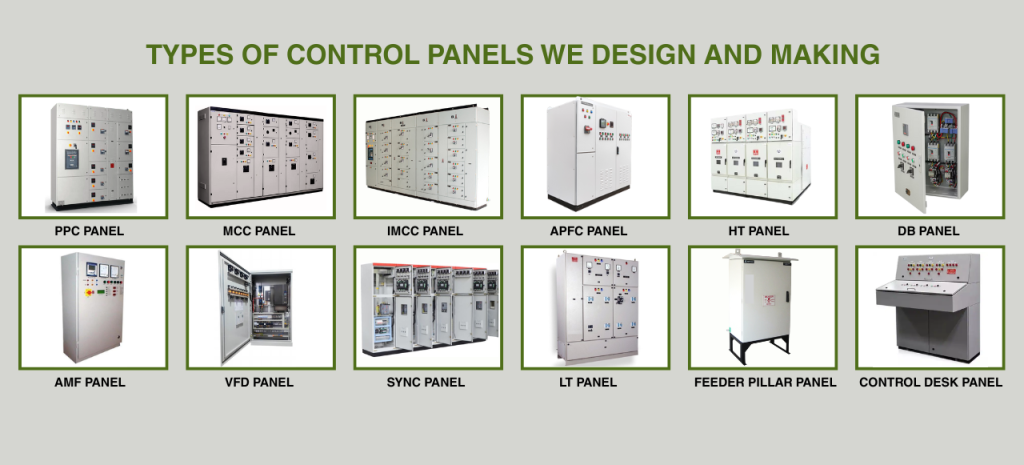
In the world of electrical engineering and industrial automation, control panels are the unsung heroes. They are enclosed structures that house vital electrical components, managing everything from power distribution to motor control and complex process automation. A well-designed control panel ensures safety, efficiency, and reliability in any operation.
Based on their specific functions and applications, control panels come in many diverse forms. Here is an overview of the essential types of control panels, like those designed and manufactured by specialized experts such as lunawat automation.
Power Distribution & Management Panels
These panels focus on the safe and efficient handling of electrical power within a facility.
LT Panel (Low Tension Panel): A primary distribution board for managing and distributing electrical power at low voltages (typically up to 1000V). It houses main circuit breakers and other protective devices.
HT Panel (High Tension Panel): Used to handle and control high voltage electrical power (above 1kV). These panels are crucial for connecting to the main utility supply and stepping down power.
DB Panel (Distribution Board Panel): A localized enclosure that distributes power from the main supply to various smaller, downstream circuits within a building or section of a plant.
Feeder Pillar Panel: Typically an outdoor, weatherproof enclosure used for power distribution in a localized area, often found in residential or industrial complexes to manage incoming and outgoing power feeders.
APFC Panel (Automatic Power Factor Correction Panel): A sophisticated panel designed to monitor and automatically improve the power factor of a system by switching capacitor banks on and off. This reduces energy costs and improves the electrical system’s efficiency.
PPC Panel (Power & Process Control Panel): A combination panel often used in process industries (like chemical or cement) to control power distribution while also managing specific process control loops.
Motor Control and Automation Panels
These panels are critical for managing the operation of electric motors, which are the workhorses of nearly every industry.
MCC Panel (Motor Control Center Panel): A centralized unit that houses all the control components (starters, protective relays, circuit breakers) necessary to start, stop, and protect multiple electric motors from a single location.
IMCC Panel (Intelligent Motor Control Center Panel): An advanced version of the MCC. It integrates smart devices like PLCs, soft starters, and communication capabilities (e.g., Modbus, Ethernet) for real-time diagnostics, remote monitoring, and greater control precision.
VFD Panel (Variable Frequency Drive Panel): This panel houses a Variable Frequency Drive (VFD) along with its associated protective and isolation components. The VFD controls the speed and torque of an AC motor, saving energy and providing precise process control.
Specialized and Emergency Power Panels
These panels handle specific control functions, often related to emergency power or complex multi-source systems.
AMF Panel (Automatic Main Failure Panel): Essential for systems relying on backup power (like a generator). The AMF panel automatically senses a failure in the main power supply, starts the standby generator, and transfers the electrical load. Once main power is restored, it transfers the load back and shuts down the generator.
SYNC Panel (Synchronization Panel): Used in facilities with multiple power sources (e.g., multiple generators or a generator and the utility grid). This panel ensures that all connected sources are perfectly matched in terms of voltage, frequency, and phase angle before being connected in parallel to share the load.
Control Desk Panel: An ergonomic, operator-friendly panel typically placed in a control room. It features push buttons, indicator lights, HMIs (Human-Machine Interfaces), and switches, allowing human operators to manually monitor and control a complex process or entire plant.
Selecting the correct type of control panel is fundamental to a system’s safety and performance. Each panel serves a unique, non-negotiable role in keeping industrial and commercial facilities running smoothly and efficiently.